
by Lisa Dzialo | Mar 5, 2019 | Blog, Tutor Interviews
Bio
Richard McManus is a committed behavioral executive who has designed and delivered training programs for executives, managers and teachers. His mission is to increase the ability of USA schools and teachers to teach reading to all students.
Richard founded The Fluency Factory after 20 years of dreaming, thinking and planning. He is and always will be committed to serving all students — both struggling students and high achieving students. He created a system of fluency charts to measure skills and build the love of learning. The charts provide a direct measurement that can be communicated immediately to the student. They can see their learning from minute to minute, day to day, week to week, in clear, graphic terms. Seeing this progress gives the student the confidence that he or she can do more, and that learning does not have to stop, or be bound by present skill deficits (more…)

by Erica L. Meltzer | Mar 1, 2019 | Blog
Back around 2013, when I was writing the original edition of The Critical Reader, I happened across research showing that one of the primary differences between teenagers’ writing and that of adults lies in the use of concessions—words like however and nevertheless and until, which are used to signal the introduction of an objection or a conflicting point. The adult writers used these types of words consistently, but they were largely absent from the students’ papers. I’ve thought about the implications of that fact in a general way before, but as I’ve recently come to realize, I’ve never really thought them through. This post is my attempt to do so. (more…)

by Erica L. Meltzer | Feb 19, 2019 | Phonics, The Science of Reading
In discussions about reading instruction, a commonly raised point is that students with reading disabilities—particularly dyslexia—suffer disproportionately when deprived of systematic instruction in phonics. In fact, this is virtually impossible to dispute—whereas many students in whole language classrooms do manage to figure out enough of the rules to become reasonably proficient readers, students who cannot make sense out of word/sound relationships have no way of keeping up. And if their difficulties are not noticed in time, or they lack access to competent reading specialists, either through their schools or privately, the consequences can indeed be extremely dire. (The percent of prison inmates with reading disabilities is, for example, astronomical.)
I’m saying this upfront because I do not want in any way to minimize the difficulties faced by these students and their parents. But what I’m interested in examining here is how some of the rhetoric surrounding reading pedagogy operates—how concepts like “normal” and “abnormal” are defined and how, in some cases, the recognition of the importance of phonics for students with reading disabilities like dyslexia can become a tool for reinforcing naturalistic ideas about reading.
According to one narrative I find particularly pernicious, a phonetic approach to teaching reading is acknowledged as acceptable, but only for children with reading disabilities; for “normal” children, it is implied, exposure to high-quality literature and participation in enjoyable activities that foster a love of reading are by themselves sufficient for reading (that is, decoding) to be learned automatically.
Incidentally, I was already planning to write this post when, by pure chance, a perfect specimen of this viewpoint appeared (as if by magic!) in my inbox, courtesy of Diane Ravitch’s blog.
In the course of a post about the insanity of subjecting kindergartners to standardized reading tests—a stance that, for the record, I agree with 100%—Ravitch cites Nancy Bailey, a former special-education teacher and Ph.D. in educational leadership, on the ways in which children learn to read. As Bailey describes:
Some children easily acquire reading skills without formal phonics instruction. They are curious about words and are able to sound letters out as they listen to and enjoy picture books. They may read well before they start school.“
Other children learn a little later. And some with disabilities may need extra assistance with a formal phonics program.
“Repeatedly testing young children to find out how they read at such an early age would be better spent reading out loud lovely, funny, engaging picture books, and letting children develop their language skills through play!”
What interests me in this passage is the way Bailey contrasts the needs of students with and without reading disabilities. Consider the phrasing: “Some children easily acquire reading skills without formal instruction.” Yes, this is true, although it only applies to a very small percentage. (Another 35% will learn to read with broad instruction.)
What Bailey says next is where things get problematic: “Other children learn a little later. And some with disabilities may need extra assistance with a formal phonics program.”
Look carefully at how this is phrased: not “other children need varying amounts of direct instruction to learn to read,” but “other children learn to read later.” Taken on its own (and in the absence of any pre-existing knowledge about Bailey’s stance on whole language), this could charitably be written off as an unintentional omission, but it is the next statement that gives the game away. By juxtaposing “other,” non-learning-disabled children and those “with disabilities, who may need extra assistance with a formal phonics program,” Bailey clearly implies that “normal” children will learn to read more slowly than children in the most exceptional group—but that they do not need formal phonics in order to acquire that skill. And that is simply not true.
Furthermore, the use of the word may suggests that even in cases where a learning disability is present, a phonetic approach is only one of many possible options. Are there other ways in which a dyslexic student might learn to read? Theoretically, yes—in the absolute sense, anything is possible. And presumably a very small percentage of students will continue to struggle despite receive intensive phonics instruction. But phonics is the only solution demonstrated to be consistently effective for students who struggle with decoding—to the best of my knowledge, there is no accepted mainstream research suggesting anything to the contrary. (And again, parents don’t pay for their children who are struggling with reading to go to whole language centers.) In light of Bailey’s other remarks, her wording here seems to imply that given enough time, some students with genuine reading disabilities will eventually just pick up the whole reading thing on their own, no intervention needed. Again, theoretically possible, but in reality… the result will probably be years of frustration.
Reading between the lines here, it is possible to catch of whiff of something vaguely… if not exactly condescending, then perhaps slightly pitying. The poor dears… They can’t learn to love reading naturally, through fun activities, like their peers. No, they need to sit with workbooks (the horror!) doing those terrible, awful, boring rote drills that won’t teach them to love reading at all.
Consider now the broader assumptions lurking behind this perspective. Phonics can be written off as something that “other,” disordered children need. Normal people do not need to learn in a structured, sequential way, or to have concepts carefully and explicitly broken down for them. Given the right environment and right set of attitudes, they just… catch it. Like magic.
Furthermore, framing the problem in these terms allows the problem to be placed squarely on the students’ shoulders. Teachers need not question their own methods because a student who fails to learn naturally must be deficient in some way and can be passed off to a trained expert, thus preserving the status quo.
What makes this such a seductive fantasy is that children without obvious learning disabilities may in fact appear to do just fine in whole-language classrooms. The words they are asked to read are mostly simple and straightforward, and they can get pretty far on memorization—particularly if no one bothers to probe their true level of understanding or has an active interest in not assessing it. (In light of many teachers’ visceral loathing of memorization, I actually find this very bizarre.) But once reading becomes more challenging—once the books no longer have pictures, and the terms are too technical to be figured out without context clues—things start to fall apart.
Richard McManus at the Fluency Factory mentioned to me recently that he sees a lot of kids who seemed okay in elementary school but are about to run headlong into a huge amount of trouble in middle school because they just can’t compensate anymore. But by then, the damage has started to accumulate. With solid instruction, students may be able to scramble back up to grade level; without it, they fall increasingly behind.
Then there are the students who continue to manage to keep skating by through the first couple of years of high school; for many of these students, a low (P)SAT or ACT score is the first real sign that something is amiss, particularly if they spend most of their in-class time doing groupwork and have grades based more on projects and class participation than on tests or papers (or if grades at their school are exceptionally inflated; or if they rely heavily on tutors for help with schoolwork, as was the case for several of my students; or if their parents call to protest every time they receive anything lower than an A-…). Unfortunately, by that point it is exceedingly difficult to play catch-up. These were among the students I saw, the ones who read in ways so disorganized that at first I could barely wrap my head around it. Without exception, they were unable to score above the high 500s in Reading on the (old) SAT or the low-mid-20s on the ACT, regardless of how much tutoring their received.
I suspect that the proliferation of students in this category also contributed to the longterm decline in SAT reading scores, and thus to the recent elimination of the vocabulary portion of the SAT. A decent percentage of the words tested could be figured out—or at least reasonably guessed at—based on their component parts (roots, prefixes, suffixes). Indeed, that was in large part the point of the test! But students who learn to read through whole language, particularly if they attend schools that do not emphasize systematic vocabulary development in the later grades, are ill-prepared to break down words that way (although if they’re lucky, they might pick up something from foreign-language class).
A striking number of my students could not distinguish between “looks/sounds like” and “is related to,” for example assuming that defer meant something like differ because the two were pronounced similarly (I saw that one on multiple occasions). At the extreme end, they might not even really notice the difference in appearance between the two—or at least not register the difference in vowels as having any particular significance for their meaning. As a result, it was impossible to help them approach what was essentially a logic test in a logical manner.
Perversely, then, the practice of treating phonics as something reserved for students with reading disorders has the inadvertent effect of making better decoders out of students diagnosed with learning disabilities (they’re the ones who get the intervention), and with producing reading disorders in students who would not otherwise have them. And even if students do not have outright reading disabilities, they may become far weaker readers than necessary.
And perhaps the biggest irony of all: no matter how joyful their early experiences, students who have difficulty reading do not like to read—once the words get hard, those six-year-olds who were oh-so-excited to participate in “literacy-building” activities suddenly get a lot less enthusiastic. A student who consistently misreads words will find it difficult to figure out just what is going on in many texts, and/or may actively misinterpret their literal meanings (often, as I observed, in ways that do not make sense). Furthermore, if they are expending too much mental energy just trying to figure out what the words say, there will be no room left over to think about the meaning.
Who could possibly enjoy such a frustrating activity?
Who would want to engage in it at all?

by Erica L. Meltzer | Feb 17, 2019 | Blog, Issues in Education
I’ve been stunned by the reaction my previous post, “Unbalanced Literacy,” has generated (a couple of people have informed that I’m all over Twitter, a platform from which I remain willfully absent—let’s just say that pithy isn’t really my thing); had I known that the debate over phonics was still capable of generating such passion, I would have written something about it a long time ago! The piece took me hours and hours to write, and I’m gratified that it’s gotten such a great response.
That said, in light of some of the queries/interview requests I’ve received, I’d like to follow up on one of the points I made in the original piece, namely the fact that some teachers are suspicious of the push for increased phonics because they believe it represents an attempt by the ed-tech industry to exploit students for financial gain—essentially, that phonics will be marketed as the One Great Solution to magically boost reading scores, and that it will be used as an excuse to create all sorts of highly profitable apps and programs that can be marketed to school districts. (more…)

by Erica L. Meltzer | Feb 9, 2019 | Blog, Issues in Education
Over the last year or so, an education reporter named Emily Hanford has published a series of exceedingly important articles about the state of phonics instruction (or rather the lack thereof) in American schools. The most in-depth piece appeared on the American Public Media project website, but what are effectively condensed versions of it have also run on NPR and the NY Times op-ed page.
If you have any interest in how reading gets taught, I highly recommend taking the time for the full-length piece in APM: it’s eye-opening and fairly disquieting. While it reiterates a number of important findings regarding the importance of phonics, its originality lies in the fact that Hanford takes on the uneasy truce between phonics and whole language that supposedly put an end to the reading wars of the 1980s and ‘90s, and points out that so-called “balanced literacy” programs often exist in name only.
In principle, this approach recognizes that both development of sound-letter relationships and consistent exposure to high-quality literature are necessary ingredients in helping students become proficient readers. What Hanford does, however, is expose just how vast a chasm exists between theory and reality. In many schools, phonics is largely neglected, or even ignored entirely, while discredited and ineffective whole-language approaches continue to dominate. (more…)
by Erica L. Meltzer | Feb 5, 2019 | Blog, Tutor Interviews
Bio
Andrea Kay McFarland is the president and founder of Kay Tutoring. She attended Yale for her B.A. in History and graduated in 2005. A Minnesota native, she also has a Master’s in Education from the University of Minnesota. Starting out as a volunteer, Andrea discovered her passion for education and tutoring in 2000. Her professional tutoring career began in 2006, when she began providing formal academic and test prep services.
While she is incredibly invested in helping her students achieve academic success, Andrea and her tutors strive to make personal connections with all of their students via their interests, realizing that each one is more than just a letter grade or a test score.As an interviewer for Yale University, Andrea has also seen the other side of the college application process and is able to bring her wealth of experience to helping students prepare for interviews and write standout admissions essays.
Andrea lives with her husband, daughter and dog in Plymouth, Minnesota. She named Kay Tutoring after her maiden name, “Kay.”
(more…)

by Erica L. Meltzer | Dec 15, 2018 | The New SAT
On her blog, Diane Ravitch recently published a link to a very important article (“Does College Board Deserve Public Subsidies?”) by Richard Phelps of Nonpartisan Education Review.
The article, which takes as its starting point the question of what role taxpayer funds should play in supporting a nominally non-profit private organization, goes far beyond what its rather dry, technocratic title would seem to imply. In fact, the implications are so head-spinning that I actually had to read the piece several times to absorb it in full. It pulls together a lot of the threads I’ve been attempting to trace over the last couple of years, and provides a plausible answer to the question of how the College Board has continued to bounce back from scandal after scandal in a way that most other organizations in its position could not. (more…)

by Lisa Dzialo | Dec 5, 2018 | Tutor Interviews
Bio
Jennifer graduated from Emory University with a BA in English and MAT in Secondary Language Arts Teaching. She began her career as a high school English teacher in 2001. After three years, she pursued an MBA from the University of Georgia, concentrating in finance and entrepreneurship. She then worked as a financial analyst for CSX Transportation.
In 2010 she returned to the education field, which is her true passion. After relocating to California in 2011, Jennifer began her career as an educator in the private sector. Since then, she has worked as an English tutor, college counselor, and SAT instructor for various companies, culminating in a position as the director of a large tutoring center in the East Bay. These experiences prepared and inspired her to open a tutoring center of her own. (more…)

by Erica L. Meltzer | Nov 13, 2018 | College Essays
image © Antonio Guillem, Shutterstock
Let’s start this post with a short pop quiz.
Which of the following options would have been most likely to appear on the vocabulary section of the old SAT?
A. lateritious
B. petrichor
C. ultracrepidarian
D. discreet
E. absquatulate
If your only experience is with the new test, or if you’ve encountered articles discussing the SAT redesign, it’s probably safe to assume you’ve heard a thing or two about all those “obscure” words that were removed from the exam in order to make it more “relevant” and aligned with “what students are doing in school” (which is… what exactly?) (more…)

by Erica L. Meltzer | Nov 2, 2018 | Blog, Tutor Interviews
Vince Kotchian grew up in small-town Connecticut and completed the honors program at Boston College, graduating with a B.A. in English Literature. Though he loved the intellectual climate of Boston, it eventually dawned on him that life would be much better without Boston’s physical climate (long, gray winters and muggy summers)! He moved to San Diego in 2007, and he’s been working full-time as a test-prep tutor and author ever since. When a student texts him that she aced the test or got into her reach school, he still literally jumps up and down and grins.
In his spare time, he likes traveling using miles and points (next trips are Spain and Japan), reading fiction (favorite authors too numerous to list but include Haruki Murakami, Karl Ove Knausgaard, and Philip Pullman), watching The Great British Bake-Off (and sometimes actually baking things), hiking and camping, and rooting for the Red Sox and Patriots. He lives in the Kensington neighborhood with his hilarious wife and their crazy cat.
Vince tutors the SAT, ACT, and GRE (and teaches classes).
He meets with students in his Sorrento Valley office or online.
(more…)

by Erica L. Meltzer | Oct 29, 2018 | Blog, The New SAT
Image credit: Essayontime.com.au
The SAT and ACT have released their scores for the class of 2018, accompanied by the predictable wailing and gnashing of teeth about persistently low levels of STEM achievement.
As Nick Anderson of the Washington Post reports:
Forty-nine percent of students in this year’s graduating class who took the SAT received a math score indicating they had a strong chance [75%] of earning at least a C in a college-level math class, according to data made public Thursday. That was significantly lower than on the reading and writing portion of the tests: 70 percent of SAT-takers reached a similar benchmark in that area.
What the article quite remarkably fails to mention is that the benchmark verbal score, 480, is a full 50 points lower than that for math. Given the discrepancy, it is entirely unsurprising that fewer students met the benchmark in math.
Let’s try some basic — and I do mean basic — critical thinking with statistics, shall we?
To understand what a 480 verbal score on the redesigned SAT actually means, consider that it translates into about 430 on the pre-2016 exam, which in turn translates into about a 350 (!) on the pre-1995 SAT.
This is not “college ready” in any meaningful sense of the term. In my experience, students scoring in this range typically struggle to do things such as identify when a statement is a sentence, or grasp the concept that texts are making arguments as opposed to “just saying stuff.” But to reiterate one of my favorite points, this is in part why the SAT was changed: the decline in reading/writing scores was becoming embarrassing. And if you can’t change the students, the only other option is to change the test, and the scoring system along with it. (more…)

by Erica L. Meltzer | Oct 20, 2018 | Blog, College Essays
Image ©Nickshot, Adobe Stock
Note, January 2022: This post was written in 2018, before the start of the Covid-19 pandemic. Obviously, many things have changed since then, not least the amount of psychological pressure that many high school students have experienced. Clearly, some of the boundaries and expectations surrounding acceptable/advisable topics for admissions essays have shifted, and applicants undoubtedly have more leeway in discussing mental-health issues than they did in the past. That said, I would still caution against making this subject the exclusive focus of your essay(s). If it happens to be relevant—and it very well might be, given the events of the last couple of years— then you should focus on discussing it in a mature way that conveys qualities such as empathy and resilience, and that demonstrates your ability to reflect insightfully on what may have been very difficult situations.
As regular readers of my blog may know, I periodically trawl the forums over at College Confidential to see what’s trending. Recently, I’ve noticed a concerning uptick in the number of students asking whether it’s appropriate for them to write about mental health issues, most frequently ADD and/or anxiety, in their college applications.
So the short answer: don’t do it.
The slightly longer version:
If you’re concerned about a drop in grades or an inconsistent transcript, talk to your guidance counselor. If these types of issues are addressed, the GC’s letter is the most appropriate place for them. If, for any reason, the GC is unable/unwilling to discuss them and the issues had a significant impact on your performance in school that unequivocally requires explanation, you can put a brief, matter of fact note in the “is there any additional information you’d like us to know?” section, but think very carefully about how you present it. Do not write your main essay about the issue. (more…)

by Erica L. Meltzer | Oct 13, 2018 | Blog, SAT vs. ACT
Image © Antonioguillem, Adobe Stock
The notion that the ACT is a curriculum-based test is one of those hoary old ideas that, like so-called “obscure words” or the “guessing penalty” on the old SAT, has apparently now achieved zombie status. In fact, I confess I thought it had more or less disappeared into the ether until I encountered it on Instagram (yes, Instagram!) of all places. And by a test-prep company no less. That made me realize it wasn’t nearly as gone as I thought. Hence this post.
The confusion stems in large part from the fact that way back, the ACT was originally designed to be aligned with a generic high school curriculum—“originally” meaning “in the 1950s.” At that point, the exam did actually test some pieces of specific factual knowledge. In the late 1980s, however, the original Social Studies and Science tests were replaced with the current Reading and Scientific Reasoning tests and, presumably recognizing that students’ exposure to specific topics varied dramatically as well as wanting to compete with the SAT, the ACT moved towards testing more general reasoning abilities. (more…)

by Erica L. Meltzer | Oct 3, 2018 | Blog, Tutor Interviews
I’m happy to introduce a new series for this blog: each month, I’ll be posting a short interview with a different tutor. While I no longer tutor myself, I still get asked for recommendations of tutors who use Critical Reader books/methods, and so I’ve decided to introduce readers to these people directly. The first installment, below, is with reading and writing specialist Valerie Erde. Valerie student-taught with me for several months, and her students have consistently achieved outstanding results on both the SAT and the ACT. She recently founded her own company, Veridian Prep.
Tell us about Veridian Prep.
VeridianPrep is a Greenwich, CT and NYC-based test prep, tutoring, and college advisory company that prides itself on a small, but highly experienced, team of subject experts that provides personalized, evidence-based, and structured instruction and guidance to get measurable results for our students and families. We believe that excellent diagnostics, high-quality instruction and materials, and individualized attention have been the keys to our students’ successes.
(more…)
by Erica L. Meltzer | Sep 15, 2018 | Uncategorized
Summer SAT prep has become a rite of passage of sorts for rising juniors, but once school starts again, the timeline can get a little fuzzy. What if that first set of scores, from a test in September or October, seems pretty solid? Is it ok to walk away, or is a retake called for, and if so, when?
Much of the time, I suspect, students’ instinct is to think, I spent all that time prepping over the summer… I have lots of stuff to do now, and I don’t want to have to think about this anymore — can’t I just stop? I want to address this because I think it’s a common question, and the answer isn’t necessarily what people want to hear. Obviously, the desire to get the standardized testing process over with as quickly as possible is understandable; however, prepping early does not — and in many cases should not — automatically translate into being done early. (more…)
by Erica L. Meltzer | Sep 8, 2018 | The New SAT
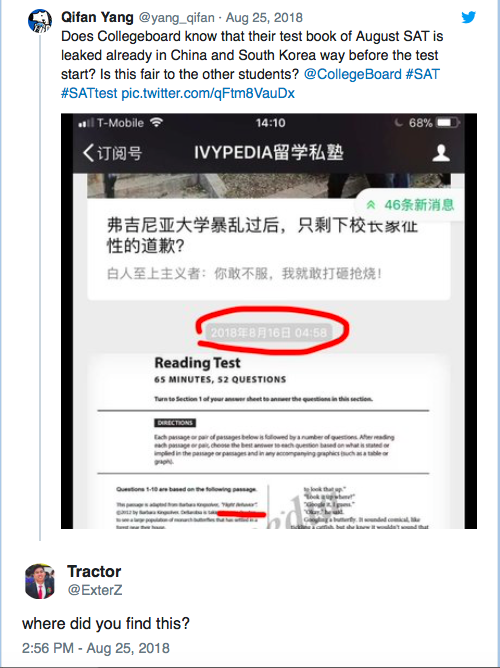
The last couple of weeks have seen some new developments in the most recent SAT scandal. Initial reports stated that some questions from the August 2018 test administered in the U.S. had been leaked in Asia before the exam. Mercedes Schneider did a little bit of digging, however, and discovered that wasn’t exactly the case. In reality, the problem goes a lot deeper—and in this case, the problem doesn’t lie with Asian testing centers or students: (more…)

by Erica L. Meltzer | Aug 24, 2018 | ACT English/SAT Writing
Note: I’m addressing this issue in part because a colleague informed me that it’s popped up in regards to my books on Reddit. If anyone comes across those questions, feel free to direct people here.
Among the simplest and most straightforward grammatical rules students studying for the SAT or ACT often learn is two commas are often used to signal non-essential information: words, phrases, and clauses that are not central to the essential meaning of a sentence, and that can be crossed out without affecting its basic grammatical structure.
The problem, of course, is that commas can be tested in many ways, and that two commas can be present in a given section for numerous reasons. Now, much of the time, two commas in an underlined section will in fact signal non-essential information, but if you’re aiming for a very high Writing/English score on the SAT or ACT, you also need to understand when this is not the case. (To read about information that is non-essential click here.) (more…)

by Erica L. Meltzer | Aug 13, 2018 | The New SAT
When scores for the June SAT were released last month, many students found themselves in for a rude surprise. Although their raw scores were higher than on their previous exam(s), their scaled scores were lower, in some cases very significantly so.
An article in The Washington Post recounted the story of Campbell Taylor, who in March scored a 1470—20 points shy of the score he needed to qualify for a scholarship at his top-choice school:
[T]he 17-year-old resolved to take the test again in June and spent the intervening months buried in SAT preparation books and working with tutors. Taylor awoke at 7:30 a.m. Wednesday and checked his latest score online. The results were disappointing: He received a 1400.
He missed one more question overall in June than in March but his score, he said, dropped precipitously. And in the math portion of the exam, he actually missed fewer questions but scored lower: Taylor said he got a 770 in March after missing five math questions but received a 720 in June after missing just three math questions. (more…)
